

|
|
|
|
|
|||||||
| Home | Forums | Gallery | Webcams | Blogs | YouTube Channel | Classifieds | Register | FAQ | Members List | Donate | Search | Today's Posts | Mark Forums Read |
 |
|
|
Thread Tools | Display Modes |
|
|
 02-09-2010, 09:10 AM
|
#1 |
|
Senior Member

Join Date: May 2005
Location: Isola Gatto Nero
Posts: 697
Thanks: 162
Thanked 263 Times in 81 Posts
|

I built mine with 3 bags of concrete, which I poured into a duck tape reinforced cardboard box. Mine is in 25' of water, and I didn't want have to do it twice, so I sunk a stainless eye bolt into the middle of it. I built the whole thing on my raft at the shore then floated it out to its final location and pushed it overboard with chain attached. I have a 24' boat at a very windy location and it has never moved as far as I can tell.
__________________
La vita è buona su Isola Gatto Nero |

|

|
|
02-09-2010, 09:46 AM
|
#2 | |
|
Senior Member

Join Date: Jul 2004
Posts: 2,985
Thanks: 246
Thanked 744 Times in 444 Posts
|
Quote:
|
|
|
|
|
|
02-09-2010, 10:07 AM
|
#3 | |
|
Senior Member
Join Date: May 2005
Location: Isola Gatto Nero
Posts: 697
Thanks: 162
Thanked 263 Times in 81 Posts
|
Quote:
"Crevice Corrosion The corrosion resistance of a stainless steel is dependent on the presence of a protective oxide layer on its surface, but it is possible under certain conditions for this oxide layer to break down, for example in reducing acids, or in some types of combustion where the atmosphere is reducing. Areas where the oxide layer can break down can also sometimes be the result of the way components are designed, for example under gaskets, in sharp re-entrant corners or associated with incomplete weld penetration or overlapping surfaces. These can all form crevices which can promote corrosion. To function as a corrosion site, a crevice has to be of sufficient width to permit entry of the corrodent, but sufficiently narrow to ensure that the corrodent remains stagnant. Accordingly crevice corrosion usually occurs in gaps a few micrometres wide, and is not found in grooves or slots in which circulation of the corrodent is possible. This problem can often be overcome by paying attention to the design of the component, in particular to avoiding formation of crevices or at least keeping them as open as possible. Crevice corrosion is a very similar mechanism to pitting corrosion; alloys resistant to one are generally resistant to both. Crevice corrosion can be viewed as a more severe form of pitting corrosion as it will occur at significantly lower temperatures than does pitting." Not sure I follow what the problem is. I figure my other choice was a galvanized eye and I don't see how that would be any better.
__________________
La vita è buona su Isola Gatto Nero |
|
|
|
|
|
02-09-2010, 11:00 AM
|
#4 | |
|
Senior Member
Join Date: Jul 2004
Posts: 2,985
Thanks: 246
Thanked 744 Times in 444 Posts
|
Quote:
In this situation, the water is the corrodent and the concrete allows water in but not to flow, so it remains stagnant. This makes the SS corrode very quickly and invisibly (it's invisible because the corrosion can only occur within the tight confines of the crevice, if it's plainly visible, there will be no corrosion). Here's a nice example of a stainless bolt compared to bronze bolt: 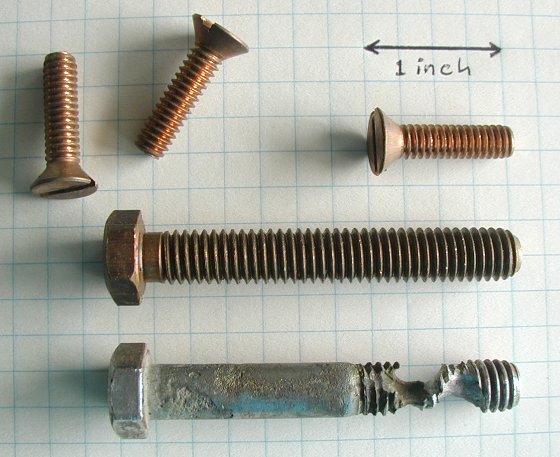
|
|
|
|
|
|
02-09-2010, 11:34 AM
|
#5 |
|
Senior Member

Join Date: Apr 2004
Posts: 5,075
Thanks: 215
Thanked 903 Times in 509 Posts
|
Sounds like evelyn has the best set-up.I can see where more wear on the chain can occur but at least it can be seen and corrected unlike eyebolt that breaks off.
__________________
SIKSUKR |
|
|
|
| Sponsored Links |
|
|
|
02-09-2010, 11:46 AM
|
#6 | |
|
Senior Member

Join Date: May 2006
Location: Texas, Lake Ray Hubbard and NH, Long Island Winnipesaukee
Posts: 2,970
Thanks: 1,064
Thanked 912 Times in 539 Posts
|
Quote:
Now the concrete block we made, with rebar has been at the bottom for ummmmm I think about 25 years now.... the chain has been replaced several times, but the rebar is still in great shape. now someone else mentioned granite..... I have heard this is much better then concrete, and I know on Lake Champlain, is very popular for moorings....
__________________
Life is about how much time you can spend relaxing... I do it on an island that isn't really an island..... |
|
|
|
|
|
02-09-2010, 12:24 PM
|
#7 |
|
Senior Member
Join Date: Aug 2004
Location: Moultonborough & CT
Posts: 2,550
Thanks: 1,072
Thanked 672 Times in 369 Posts
|
Yes but
didn't the same site being copied and pasted also say....
Crevice corrosion occurs in stainless steel and other metals when the metal is covered, but immersed in a corrosive liquid such as seawater. |
|
|
|
|
02-09-2010, 12:55 PM
|
#8 | |
|
Senior Member
Join Date: Jul 2004
Posts: 2,985
Thanks: 246
Thanked 744 Times in 444 Posts
|
Quote:
|
|
|
|
|
| The Following User Says Thank You to Dave R For This Useful Post: | ||
Pineedles (02-09-2010) | ||
|
02-11-2010, 09:12 AM
|
#9 | ||
|
Senior Member

Join Date: Jan 2005
Location: Florida (Sebring & Keys), Wolfeboro
Posts: 6,028
Thanks: 2,285
Thanked 789 Times in 564 Posts
|
 Eek!
Eek!
Quote:
 A ½-inch diameter galvanized U-bolt used on our original mooring block has disappeared entirely after 54 years. (Well, there are two brown spots remaining.  ) )As to narrow anchorages, a new Chapman NIB text—marked "100" at a yard sale, which turned out to be just $1  —suggests three mooring blocks. Two should be placed to the strongest wind direction and all three attached together with chain with a central shackle pickup point. —suggests three mooring blocks. Two should be placed to the strongest wind direction and all three attached together with chain with a central shackle pickup point. Chapman advises "hot-galvanized" steel, which may be that process that wrinkles the galvanized finish to a thicker coating. Chapman also suggests switching mooring chains end-for-end each season. (Although a heavy nylon line should be fine for a 19' sailboat mooring). A friend just ½-mile from me has been using a stainless steel mooring cable—for 40 years! (For a 19' Cape Dory Typhoon sailboat). For confirmation of the suggestion found in Chapman, check out this chain: http://www.winnipesaukee.com/forums/...06&postcount=5 Quote:
Since I seek-out new (and used) stainless steel objects at every opportunity, I discovered some deep crevice corrosion on a very important object that hasn't been covered in this thread. That piece was a boat's 2nd-hand bow eye! 
|
||
|
|
|
|
| Bookmarks |
| Thread Tools | |
| Display Modes | |
|
|


 Hybrid Mode
